
In 2025, the global bathroom accessories market size was USD 63.26 billion; by 2035, this figure will become USD 128.93 billion, with a compound annual growth rate of 7.38%.
This is an "old" market, where European and American brands such as Kohler, Moen, and Grohe have dominated for nearly a century. In the global bathroom accessories market, urban housing penetration exceeding 62%, water-saving device adoption of 58%, and renovation-driven installation growth of nearly 45% are all continuously driving expansion of this market. But this is also a "new" market: existing-home renovation, smart consumption upgrades, and the popularity of DIY home improvement are reshaping the consumption logic of bathroom accessories. Online sales already account for 29% of the total market, and digital channels are breaking the traditional retail landscape of the bathroom industry.

Image source: global growth insights
In this market where old and new intertwine, a brand from Xiamen, China — Hibbent — is quietly gaining momentum.
According to data, Hibbent's monthly sales in the TikTok US region are close to $900,000. This performance is not dazzling, but it sufficiently proves one thing: bathroom accessories, a seemingly traditional category, can also become a bestseller in interest-based e-commerce on TikTok.

Image source: Hibbent
A Pioneer of Going Global Grown in the Soil
Hibbent is a brand focused on the home accessories field, with its main operating entity being Xiamen Shengjiu Technology Co., Ltd. Public trademark records show that the company began laying out bathroom-related products early on and has continued to expand overseas markets.
From a product layout perspective, Hibbent did not start with large bathroom equipment such as high-priced smart toilets, but rather chose small accessories that consumers find easier to accept, including toilet seats, smart bidets, shower heads, faucet aerators, and other products.
These products have several distinct characteristics: low installation barriers, clear usage scenarios, and short consumer decision cycles, making them more suitable for rapid sales through cross-border e-commerce.

Image source: Hibbent
At the brand's inception, Hibbent proposed the philosophy of "improving consumers' living experience while protecting the environment," and built its product positioning around the phrase "Less water, less toilet paper, less spending."
For example, the brand uses faucet aerators with air-mixing technology to reduce water consumption, and non-electric smart bidets to help consumers reduce toilet paper use.
After years of overseas market operations, Hibbent products have been sold to many countries including the United States, Canada, the United Kingdom, Germany, France, Italy, Australia, Spain, Japan, and others. The brand has also established warehousing systems in regions such as China, the United States, the United Kingdom, Germany, and Canada to improve delivery experiences for overseas consumers.

Image source: Hibbent
How to play on TikTok? Instead of investing in top influencers, invest in a "sense of authenticity."
Hibbent's approach on TikTok is quite different from that of many brands.
Many brands' first reaction to TikTok is to find top influencers and spend heavily on advertising. Hibbent is taking a different path: an influencer matrix plus scenario-based content.

Image source: kalodata
Content level: visual impact + lowering the barrier
Bathroom products have a natural disadvantage — they are not photogenic. Faucets, shower heads, and toilet accessories placed on Amazon's image-and-text detail pages make it difficult for consumers to feel what they are actually useful for.
Hibbent solved this problem on TikTok.
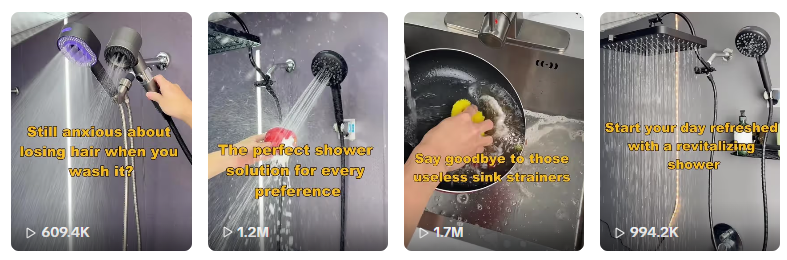
One type is installation tutorial videos. A large amount of content revolves around installation guides: screwing in bolts, connecting water pipes, and adjusting water flow, accompanied by crisp ASMR sounds.

Image source: TikTok
Take a video posted by the brand's official account @oriomuskshare as an example. The content starts with unboxing the shower head, quickly showing the complete installation process and final water flow effect of the black minimalist shower head, without any unnecessary narration throughout.
This content format of 'installation process plus usage effect' allows users to intuitively see the product change from parts to finished product, greatly lowering the decision-making threshold. The video reached 3.1 million views and directly drove sales of $38,700, which is obviously quite effective.

Image source: TikTok
Another type is comparison videos. Influencer @bigbsfinds posted content about upgrading a sink drain. At the beginning of the video, he directly holds the old and new products for comparison, with titles like 'Kitchen upgrade you didn't think of', giving users the perception gap of 'so this can also be replaced'.
Then it shows the installation process and usage tests, clearly answering in one go whether it is easy to install, whether it is useful, and whether it improves the experience. This video reached 7.6 million views and drove sales of $21,000.
It can be seen that this content strategy of 'first discover the problem, then accept the solution' is indeed more efficient in conversion than direct promotion.

Image source: TikTok
Influencer strategy: extensive seeding with KOC + endorsement by vertical KOL
One of the important features of TikTok Shop is that brands can leverage the affiliate marketing system to let a large number of creators participate in product promotion. In its promotion process, Hibbent also tends to find creators in areas such as home good sharing, lifestyle, and DIY renovation.
Compared with traditional advertising, this influencer content is closer to the real life of consumers.

Image source: kalodata
Take influencer account @happyheartandhome as an example. This influencer has long shared home goods and life tips, and the content style is highly consistent with the usage scenarios of Hibbent products.
When promoting Hibbent-related products, she did not simply introduce product parameters, but instead showed through everyday usage scenarios how bathroom accessories solve practical problems. This video ultimately gained over 19.14 million views and drove about $61,100 in transaction value for the product.
For Hibbent, this type of influencer content not only brings direct sales conversion, but also further strengthens consumers' awareness of the product's practical value, making bathroom accessories that were originally more functional more likely to enter users' purchase decisions.

Image source: kalodata
Final Thoughts
Looking back, opportunities in the bathroom accessories track have always been there. The difference is that in the past, these opportunities belonged to Kohler, Moen, and those Western giants with a century of accumulation, global channels, and brand premium.
But now it's different.
TikTok has changed the logic of traffic distribution, cross-border e-commerce has changed the entry barriers of channels, and China's supply chain has changed the cost structure of products.
For domestic enterprises targeting overseas markets, Hibbent's story at least illustrates one thing: don't be intimidated by 'monopoly of giants'. There are new gaps in old markets, new demands in old categories, and new traffic outside old channels.
Now is perhaps the right time to go overseas.
What this signal means for growth teams
This market signal should be treated as an operating prompt, not a standalone trend. The brand question is whether the team can connect TikTok content, creators, paid media, commerce readiness, and reporting into one measurable growth cycle.
Commercial read
- Market signal: TikTok marketing tips - short video marketing methods
- Published: August 4, 2026
- Commercial lens: TikTok Ads, creators, TikTok Shop, live commerce, and reporting.
- Source transparency: the original source linked in this article
What brands should do next
- Identify the market, audience, product group, and KPI this signal could affect.
- Turn the insight into a small TikTok creative, creator, Shop, or paid media test before scaling spend.
- Add FAQ, offer clarity, product proof, and contact paths so traffic can convert instead of only reading.
- Review weekly performance across reach, click quality, Shop actions, creator output, and revenue impact.
Tuke Marketing helps brands connect TikTok Ads, creator partnerships, TikTok Shop operations, live commerce, and reporting into one accountable operating system.
What should brands do with this TikTok signal?
Brands should translate the signal into a focused operating test across creative, creators, TikTok Shop readiness, paid media, and reporting before increasing budget.
How does Tuke Marketing evaluate this kind of news?
Tuke Marketing reviews platform news through market timing, category demand, creator supply, commerce readiness, and measurable growth actions.
When should a team contact Tuke about this topic?
A team should contact Tuke when it needs to turn a TikTok market signal into a practical launch, creator, advertising, live commerce, or reporting plan.
Source transparency: Tuke cites the original source linked in this article and adds its own operating analysis for brands evaluating TikTok growth decisions.