
Those who have worked in cross-border industries know that the domestic industrial chain has inherent advantages.
Take the World Cup, which has been the global focus recently, for example: Cape Verde jerseys became an overnight sensation in overseas markets. Traffic comes suddenly, but converting it into actual sales is not easy.
However, the strong rapid production capacity of places like Yiwu and Wenzhou allowed many merchants to firmly seize this trend, achieving hundreds of thousands of GMV in just one month, turning the buzz into real revenue.

Source: Google
Besides the outstanding advantages of small commodity exports, large items are the same.
For instance, the furniture industry belt in the Pearl River Delta and Zhaoqing in China has the world's most complete home furnishing supply chain and is also the core supply side for global home furnishing exports.
Relying on these unique supply chain conditions, many top cross-border furniture sellers have emerged here.
Homary, which we will discuss today, is a typical example.
Now, let's study together how this original home furnishing export brand born in Guangzhou, Guangdong, achieved annual revenue of over 2 billion yuan and successfully ranked among the top ten home furnishing e-commerce platforms in North America and Europe.

Source: Homary
Born from market pain points
According to public information, Homary is a leading DTC cross-border brand for large home furnishing items in China.
In 2012, the brand founder was inspired by overseas home furnishing magazines and keenly captured the pain points of the European and American markets:
Local consumers are keen on rental renovations, new house and yard decoration. When choosing furniture, they not only value basic practical functions but also increasingly emphasize spatial aesthetics and a cozy atmosphere at home, willing to pay a premium for designer home products. However, overseas high-end designer furniture is generally very expensive, making it hard for ordinary middle-class families to afford.
Targeting this market gap, the founder decided to focus on middle-class families in Europe and America, offering light luxury home furnishings that combine design sense and cost-effectiveness. In 2012, Homary was officially founded, with its name derived from Home + -ary, meaning everything related to home.

Source: Homary
Start with small items to test the waters, then expand to full-category large items
In the early stages of development, limited by the imperfect cross-border logistics and overseas warehouse support for large furniture, the team chose to enter the cross-border track with bathroom hardware small items, testing the market first.
In 2017, Homary reached a turning point for scaling. The brand set up an overseas warehouse in the United States, solving two core challenges: cross-border delivery of large furniture and after-sales returns and exchanges. At the same time, it began expanding into full categories, extending from bathroom small items to sofas, bed frames, outdoor furniture, lighting, and other whole-house home categories, officially entering the large furniture track.
Meanwhile, the team also built a localized customer service and overseas operations team, continuously refining the flexible supply chain system.
Relying on the mature and complete home furnishing industry chain advantage of the Pearl River Delta, Homary can quickly produce samples and continuously launch multiple SKU products. Compared with local overseas manufacturers, the brand follows the iteration speed of soft furnishing trends faster and offers a richer variety of styles, gaining recognition from a large number of overseas consumers.

Source: Homary
Independent website as the main channel, third-party platforms as supplements
To build diversified sales channels and make it convenient for overseas consumers to shop, Homary adopted a strategy of using third-party platforms to attract traffic and acquire customers, while using its independent website to沉淀 private domain traffic.
The independent website is Homary's core battleground. The brand has established multi-regional sites, adapting to the currencies, logistics, tax rules, and local aesthetic preferences of different markets.
At the same time, through fine-grained three-level product categorization and regular limited-time promotions, it continuously retains users and increases repurchase rates.

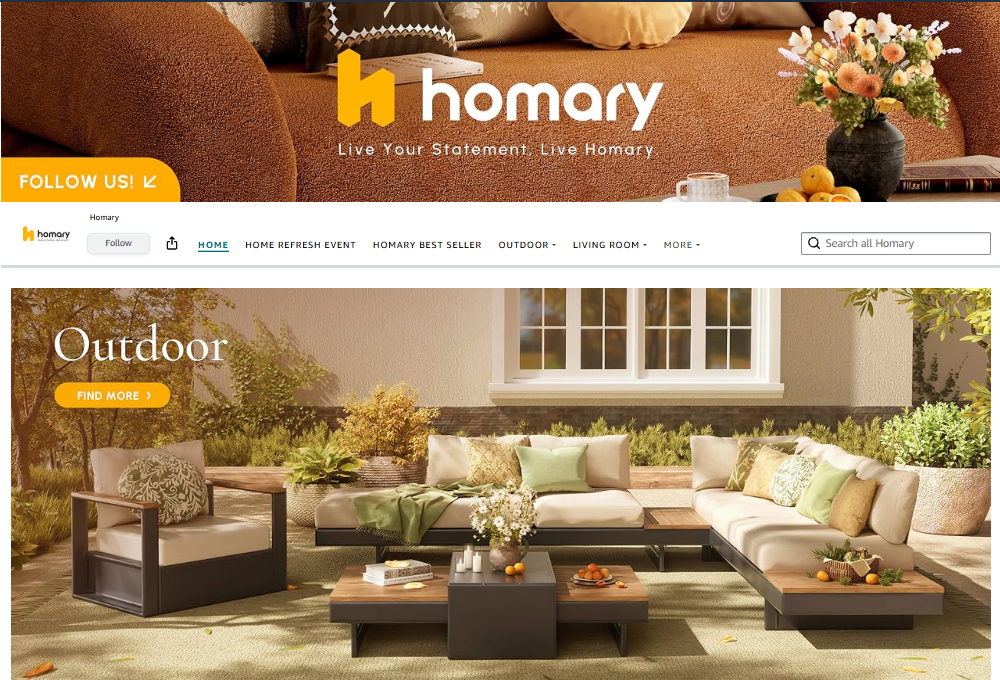
Source: Homary
In addition, the brand has also entered Amazon and Wayfair, two major home furnishing platforms in Europe and America, as supplementary traffic channels. It leverages the platforms' built-in traffic to quickly cover broad consumer groups and achieve brand exposure.
It is reported that in 2025, Homary's annual revenue surpassed the 2 billion yuan mark.
Today, it has maturely operated in 18 core markets including the United States, Canada, and the United Kingdom, and can deliver products to more than 50 countries and regions worldwide. It is one of the top benchmark brands in the DTC track of Chinese overseas online light luxury large home furnishing in Europe and America.

Source: Amazon
Leveraging the wave of short video content to lower the customer acquisition threshold for the home furnishing category.
For home products, a strongly scene-based category, short video content featuring before-and-after comparisons of home renovations, furniture unboxing, and soft furnishing matching is highly aligned with European and American users' browsing preferences and easily goes viral.
Relying on this characteristic, Homary has fully seized the traffic dividends of TikTok, making it the core battleground for overseas marketing.
On TikTok, the brand operates its official account @Homary. As of now, it has 39,000 followers and 248,800 total likes.

Source: TikTok
At the content level, this account adopts an operational approach of full SKU wide exposure, with videos covering various home items such as sofas, tables and chairs, lighting, and storage cabinets.
When potential buyers enter the homepage, they can intuitively see a rich product matrix, effectively stimulating purchase interest and increasing the intention to add to cart.

Source: TikTok
Because the brand account's reach is limited, Homary has not relied solely on this channel. It has also simultaneously carried out extensive collaborations with TikTok influencers, leveraging the influencers' own follower base and influence to continuously expand brand exposure.
For example, TikTok unboxing and sharing influencer @Black style, who has 514,000 followers, once filmed a promotional short video for Homary.

Source: TikTok
The entire video is only 22 seconds long, fully presenting the scenes of sofa unboxing, assembly, and on-site experience. This simple and straightforward real-life content better retains viewers and increases the video completion rate.
Since its release, the video's views have exceeded 1.1 million and likes have reached 106,100. A large number of viewers have developed purchase interest after watching, leaving comments to inquire about product purchase channels.
It is not hard to see that influencer real-shot unboxing, assembly, and genuine experience content can effectively dispel overseas consumers' purchase doubts, significantly boosting lead generation and conversion.

Source: TikTok
It's time to go global: The window for mid-range designed home furnishing has opened.
Looking at the current overseas expansion tracks, the heat of the mid-range designed home furnishing segment in European and American markets continues to rise. Supply chain advantages are not the only trump card for Chinese companies; what matters more is how to transform manufacturing capabilities into brand recognition.
Homary's development trajectory confirms a fact: In today's era where short video platforms like TikTok are reshaping consumer decision paths, the home furnishings category no longer relies solely on search traffic, and the power of scenario-based content to generate desire is becoming a new competitive barrier.
For domestic companies, the overseas market's demand for cost-effective design-oriented home furnishings is far from saturated, especially for brands that can combine localized aesthetics with rapid response, which still have broad room for growth.
Whether it's the maturity of logistics infrastructure or the traffic mechanisms of content platforms, both provide newcomers with a more favorable foundational environment than a decade ago.
This market is waiting for more explorers who are willing to take risks.
What this signal means for growth teams
This market signal should be treated as an operating prompt, not a standalone trend. The brand question is whether the team can connect TikTok content, creators, paid media, commerce readiness, and reporting into one measurable growth cycle.
Commercial read
- Market signal: TikTok marketing tips - short video marketing methods
- Published: July 23, 2026
- Commercial lens: TikTok Ads, creators, TikTok Shop, live commerce, and reporting.
- Source transparency: the original source linked in this article
What brands should do next
- Identify the market, audience, product group, and KPI this signal could affect.
- Turn the insight into a small TikTok creative, creator, Shop, or paid media test before scaling spend.
- Add FAQ, offer clarity, product proof, and contact paths so traffic can convert instead of only reading.
- Review weekly performance across reach, click quality, Shop actions, creator output, and revenue impact.
Tuke Marketing helps brands connect TikTok Ads, creator partnerships, TikTok Shop operations, live commerce, and reporting into one accountable operating system.
What should brands do with this TikTok signal?
Brands should translate the signal into a focused operating test across creative, creators, TikTok Shop readiness, paid media, and reporting before increasing budget.
How does Tuke Marketing evaluate this kind of news?
Tuke Marketing reviews platform news through market timing, category demand, creator supply, commerce readiness, and measurable growth actions.
When should a team contact Tuke about this topic?
A team should contact Tuke when it needs to turn a TikTok market signal into a practical launch, creator, advertising, live commerce, or reporting plan.
Source transparency: Tuke cites the original source linked in this article and adds its own operating analysis for brands evaluating TikTok growth decisions.