
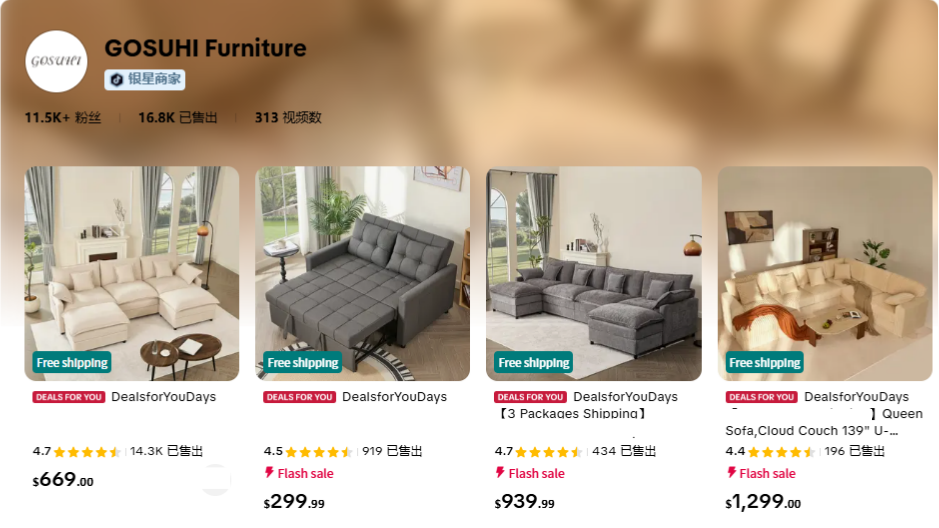
There used to be a common belief in the industry: large, high-ticket items are not suitable for selling on impulse-driven social media e-commerce. After all, who would casually place an order for a sofa costing hundreds or thousands of dollars while browsing short videos? However, GOSUHI, a brand from Ningbo, has managed to turn this “impossible” task into reality.
According to statistics from third-party data platforms, as of recently, GOSUHI's total sales on TikTok have reached $10,514,100, with sales in the last 30 days amounting to $2,248,600.
This figure is quite impressive in the furniture category and forces a re-evaluation of the old notion that “large items are not suitable for social media.”

Source: TikTok Shop
From Ningbo Factory to American Living Rooms
GOSUHI's positioning is very focused: targeting young families in European and American markets who rent homes, move frequently, and whose living rooms may not even be as large as a double bed.
The brand's English slogan is “Designed for Young Homes,” which translates directly to “designed for young homes.” It clearly conveys who the target users are in one sentence.

Source: Instagram
So how do they do it? The brand hits a very clever point — modularity.
Traditional sofas are large and heavy, difficult to get into elevators, and far from friendly for small apartments. GOSUHI's approach is to break the sofa into independent single seats, armrests, and footstools. Consumers can take them home without any tools, assemble them like LEGO bricks, and arrange them according to the size of their living room — completely on their own terms.
Currently, the brand mainly sells in the North American market, with channels including Amazon and TikTok Shop advancing simultaneously.
The pricing is very competitive. The main products range from $299 to $1,200. The popular 108-inch cloud sofa sells for $569 during TikTok promotions, and the 52-inch folding model is even available for just $239.
Compared to traditional North American brands with price tags often reaching thousands of dollars, GOSUHI quickly gained a foothold thanks to its comfortable seating, durable resilience, and reasonable pricing.

Source: Amazon
Industry Trend: TikTok is Rewriting Furniture Retail Rules
GOSUHI's success on TikTok is, to some extent, a result of riding the wave of industry change. In the past, people thought large furniture was unsuitable for social media e-commerce, but the status quo is being rewritten.
TikTok Shop US market is no longer just a platform for low-ticket hit products. According to the 2025 US TikTok Furniture Industry Report, furniture category sales grew 13.27% month-over-month, higher than the 7.64% increase in sales volume, indicating a shift toward higher-ticket, higher-value products.
The same report also mentioned that sales in the $500+ price band grew 249.333% month-over-month, indicating that high-ticket furniture is not without opportunity, but is instead gaining more consumer attention.

Source: Gloda
From a platform perspective, TikTok Shop's US business achieved a GMV of $15.1 billion in 2025, a year-over-year increase of 68%, showing that the platform's e-commerce capabilities are still expanding.
Behind these numbers is a clear signal: short-video platforms have completed the closed loop from “seeding” to “transaction.” Consumers are no longer just looking at furniture and thinking about furniture on TikTok; they are directly buying furniture on TikTok.
For Chinese brands like GOSUHI, which have supply chain advantages and distinctive products, this opens a door that previously did not exist.

Source: TikTok
TikTok in Practice: How to “Soften” Large Furniture with Content
With a good product and favorable market conditions, GOSUHI's strategy on TikTok can be summed up in three keywords: immersive content, influencer matrix, and TikTok Shop closed loop.
Keyword 1: Immersive 'Seeding'
GOSUHI's official account @gosuhifurniture rarely posts hard-sell videos. Instead, its content is filled with home aesthetics.
Video scenes often feature the tranquil light and shadow of afternoon sun on a beige linen sofa, or daily perspectives of someone sitting deep in the sofa reading or relaxing. Accompanied by gentle, stress-relieving BGM, the brand sells an ideal of 'Slow Living' directly to Gen Z and Millennials.

Source: TikTok
For example, @gosuhifurniture once posted a typical immersive home video: the scene is dominated by soft natural light, with a dark charcoal gray velvet sofa contrasting with a white chunky knit blanket, the warm glow of an electric fireplace intertwined with the soft light from a floor lamp, creating a calm and sophisticated home atmosphere.
The camera uses smooth handheld pans with slow tracking shots—wide angles show the spatial layout, while medium shots highlight the sofa's fabric texture and its soft, bouncy feel. The entire video has no salesy copy, only peaceful daily scenes and soothing background music. This video eventually gained 739,900 views and brought in $61,100 in sales for the brand.

Source: TikTok
Keyword 2: Massive Long-Tail Influencer Matrix
What is the biggest pain point of buying furniture online? Assembly. GOSUHI's strategy is to use a large number of influencer short videos to dispel this concern.
The brand sponsors a wide range of bloggers—moms, renters, and young couples—who film the entire process from package delivery and unboxing to easy solo assembly. These 'unboxing' videos are naturally satisfying and highly shareable on TikTok.
What's more interesting is the content copy design. Influencers often describe GOSUHI with phrases like 'This sofa is dangerously comfortable—once you lie down, you can't get up' or 'The ultimate affordable alternative to high-end cloud sofas,' using highly internet-savvy expressions for genuine experience sharing.

Source: kalodata
For instance, a promotional video by influencer @jack_starke is a good example. It opens with an empty corner in the living room, then cuts to the GOSUHI sofa fully assembled—the before-and-after contrast creates a powerful visual impact.
With a price tag of 'less than $600' and a line like 'This is the most comfortable sofa I've ever slept on,' the video quickly generated $31,200 in sales, showing impressive conversion.

Source: TikTok
Keyword 3: Rooted in the TikTok Shop Closed Loop
Of course, the final conversion of traffic relies on the closed-loop infrastructure of TikTok Shop. By eliminating middlemen through a direct sales model, GOSUHI's bestsellers like the 108-inch U-shaped sofa have achieved single product sales exceeding 10,000 units in the TikTok Shop.
More importantly, GOSUHI is very good at leveraging the platform's momentum and closely following major promotional events. Whether it's #dealsforyoudays, Black Friday promotions, or summer sales, they coordinate with the platform to offer big coupons and discount codes. Large furniture items that once seemed out of reach become hot items that users rush to snatch up under 'limited-time special offers'.

Source: TikTok Shop
Conclusion
Looking back at the GOSUHI case, what it truly did right may not just be 'selling sofas on TikTok.'
It turned a product that was 'not suitable for impulse e-commerce' into a content vehicle perfect for short-video platforms. The sofa is still the sofa, but GOSUHI didn't sell it as a piece of furniture—it operated it as an entry point to a lifestyle.
Here's a question to ponder: In what form should your product appear on content platforms?
If you understand this point, perhaps you are not far from creating a viral hit.
What this signal means for growth teams
This market signal should be treated as an operating prompt, not a standalone trend. The brand question is whether the team can connect TikTok content, creators, paid media, commerce readiness, and reporting into one measurable growth cycle.
Commercial read
- Market signal: TikTok marketing tips - short video marketing methods
- Published: July 4, 2026
- Commercial lens: TikTok Ads, creators, TikTok Shop, live commerce, and reporting.
- Source transparency: the original source linked in this article
What brands should do next
- Identify the market, audience, product group, and KPI this signal could affect.
- Turn the insight into a small TikTok creative, creator, Shop, or paid media test before scaling spend.
- Add FAQ, offer clarity, product proof, and contact paths so traffic can convert instead of only reading.
- Review weekly performance across reach, click quality, Shop actions, creator output, and revenue impact.
Tuke Marketing helps brands connect TikTok Ads, creator partnerships, TikTok Shop operations, live commerce, and reporting into one accountable operating system.
What should brands do with this TikTok signal?
Brands should translate the signal into a focused operating test across creative, creators, TikTok Shop readiness, paid media, and reporting before increasing budget.
How does Tuke Marketing evaluate this kind of news?
Tuke Marketing reviews platform news through market timing, category demand, creator supply, commerce readiness, and measurable growth actions.
When should a team contact Tuke about this topic?
A team should contact Tuke when it needs to turn a TikTok market signal into a practical launch, creator, advertising, live commerce, or reporting plan.
Source transparency: Tuke cites the original source linked in this article and adds its own operating analysis for brands evaluating TikTok growth decisions.