
People are naturally good at finding inspiration from daily troubles, developing effective solutions for the pain points in life. As the public's demand for certain useful products grows, business opportunities follow.
For example, in recent years, global environmental awareness has been fully enhanced, and the calls to resist plastic pollution and protect marine ecology are growing louder. When selecting cosmetics and daily necessities, consumers increasingly prefer green, low-carbon, and environmentally friendly options.
Among them, the change in consumption tendency for household cleaning products is particularly obvious: they prioritize core features such as zero-plastic certification, natural plant-based non-toxic formulas, zero chemical volatilization, and safe use for pets and children.

Image source: Google
The industry has also broken away from the traditional single marketing logic of only emphasizing stain removal, creating a triple core value of cleaning + health + environmental protection. It accurately hits the needs of countless mothers and pet-owning families, directly driving this niche track into a period of rapid growth.
According to industry data from technavio:
The global household cleaning product market has been steadily increasing year by year. It is expected to grow at a compound annual growth rate of 4.8% from 2025 to 2030, reaching a scale of $17.91 billion.

Image source: technavio
In this cleaning track focused on environmental protection and health, many new industry players with unique insights have emerged.
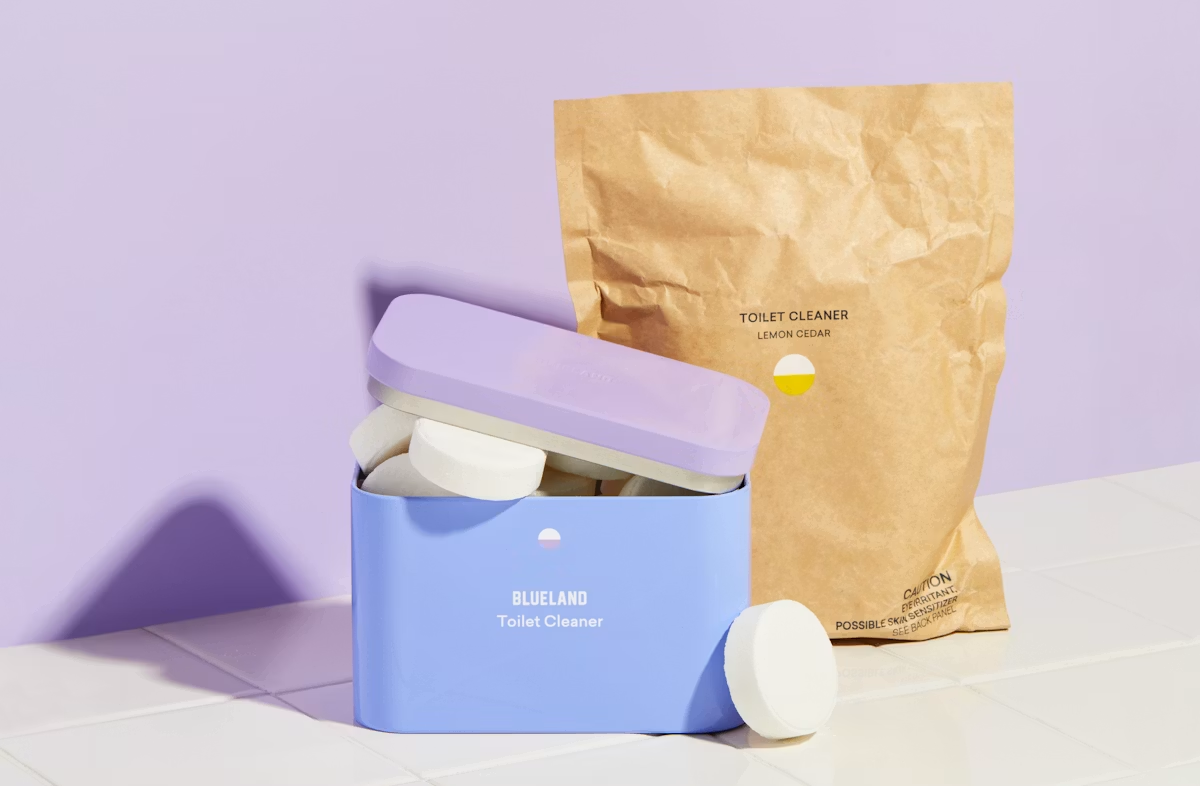
The Blueland we are introducing today is a typical example.
Next, let's explore together: what exactly has allowed it to accumulate a large number of loyal users in the global market and become a blockbuster seller with over 500 million yuan in annual revenue?

Image source: Google
Rooted in a mother's love, deeply cultivating the plastic-free cleaning track
According to public information, Blueland's founder Sarah Paiji Yoo is a mother who graduated from Harvard Business School.
Once, while preparing milk powder for her son, she accidentally detected a large amount of microplastic pollution in the local tap water and bottled water in the United States.
At the same time, she found that traditional household cleaning products have huge resource waste and environmental hazards: 90% of the ingredients in most bottled cleaners on the market are just water, yet they use disposable plastic bottles for packaging and transportation throughout the process, not only consuming a lot of logistics energy but also generating massive amounts of plastic waste.
Based on this situation, she decided to develop new cleaning products without plastic packaging. Upholding the brand's original intention of protecting the ocean, Blueland was officially established in 2019.

Image source: Google
The R&D team completely abandoned the traditional liquid bottled product form and developed dissolvable concentrated cleaning tablets with no VOCs and plant-based formulas, paired with reusable permanent cleaning bottles. Suitable for all scenarios including mothers, babies, and pet households, and the refills are only packaged in kraft paper, truly achieving zero single-use plastic pollution throughout the entire process.
The brand's debut set was launched on Earth Day, April 22 of the same year, including cleaning tablets for multi-surface, glass, and bathroom categories, along with shatterproof permanent bottles.
Upon its release, it received high recognition from capital and the market, successfully completing a $3 million seed round; within just 7 months of launch, Blueland's sales exceeded $42 million, a very impressive start.

Image source: Google
Independent website as a nest to attract customers, multiple platforms as a wide net to catch fish
To achieve long-term stable development, Blueland adopted a sales strategy with the independent website as the main channel and third-party platforms as supplements.
Within its independent website, the brand has established a dual sales system of one-time retail and long-term subscription, offering subscribers exclusive long-term discounts of 10%-20% and tiered bundle benefits, effectively increasing customer unit price and consumption stickiness.

Image source: Blueland
While deeply cultivating private domain traffic, Blueland also actively leverages various third-party e-commerce platforms to expand sales channels and tap into incremental growth.
The brand first entered Amazon, precisely capturing search traffic on the platform and supplementing brand public exposure; it also partnered with QVC TV shopping platform to achieve efficient conversion through live TV broadcasts; and then entered vertical eco-friendly e-commerce platforms like Thrive Market, targeting the core consumer circles that favor natural organic and environmental protection, achieving precise traffic matching and efficient conversion.

Image source: Amazon
Precise product positioning and comprehensive channel layout have enabled Blueland to achieve sustained high growth.
Data shows that in fiscal year 2025, Blueland's full-year net revenue exceeded $78.6 million (over RMB 500 million), with annual sales of cleaning tablet refill packs reaching 18 million sets.
As of March 2026, the brand's total omnichannel lifetime sales have reached $300 million (over RMB 2 billion), firmly holding a leading position in the plastic-free household cleaning track.

Image source: Google
Leveraging TikTok to break through circles, driving spontaneous consumption among Gen Z
For innovative products to quickly gain market recognition, impress consumers, and drive conversion, they cannot do without the traffic empowerment and influencer marketing of social media, and Blueland is no exception.
To solidify brand awareness and convey core environmental values, Blueland officially joined TikTok and created its exclusive account @Blueland. It now has 115,000 followers and has received 3.3 million cumulative likes.
Distinct from rigid product promotion, the brand focuses on visual educational short videos. By showing real footage of microplastic hazards in tap water, environmental pollution caused by landfill of traditional plastic cleaners, and contrast shots of cleaning tablets rapidly dissolving in water, it uses intuitive visual impact to convey the brand's core value of being plastic-free, safe, and eco-friendly, thereby enhancing user recognition and purchase intent.

Image source: TikTok
In addition to regular operation of its official account, Blueland also collaborates long-term with home cleaning niche influencers, using diversified content forms such as in-depth reviews to intuitively highlight the core performance advantages of its products.
Among them, the brand's collaboration with niche influencer @NonToxicDad, who has 570,300 followers, is highly creative.

Image source: TikTok
This influencer mainly shares content about everyday supermarket shopping, with a genuine persona and strong audience empathy.
In the customized promotional video, he uses daily shopping scenes as an entry point, naturally promoting Blueland's cleaning tablets, praising the advantages of the ultra-clean formula and emphasizing that the product leaves no harmful residues.
Within just three days of its release, the video garnered 354,300 views and 43,700 likes. It shows that this lifestyle-oriented embedding method reduces the sense of marketing, and authentic, down-to-earth content is more easily accepted by users.

Image source: TikTok
Video sourced from influencer @NonToxicDad's TikTok account
Conclusion
Looking at the current landscape of going global, the window for the eco-friendly cleaning category is still wide open. To enter now, the competition is no longer about who can make more fancy bottles, but who can do subtraction in product form and addition in user experience and content empathy.
The overseas market is waiting with great tolerance for new problem solvers. The key is whether you are willing, like Blueland, to dig out from the most inconspicuous detail of daily life the fulcrum that can leverage consumer spending, and write your own growth story.
What this signal means for growth teams
This market signal should be treated as an operating prompt, not a standalone trend. The brand question is whether the team can connect TikTok content, creators, paid media, commerce readiness, and reporting into one measurable growth cycle.
Commercial read
- Market signal: TikTok marketing tips - short video marketing methods
- Published: June 29, 2026
- Commercial lens: TikTok Ads, creators, TikTok Shop, live commerce, and reporting.
- Source transparency: the original source linked in this article
What brands should do next
- Identify the market, audience, product group, and KPI this signal could affect.
- Turn the insight into a small TikTok creative, creator, Shop, or paid media test before scaling spend.
- Add FAQ, offer clarity, product proof, and contact paths so traffic can convert instead of only reading.
- Review weekly performance across reach, click quality, Shop actions, creator output, and revenue impact.
Tuke Marketing helps brands connect TikTok Ads, creator partnerships, TikTok Shop operations, live commerce, and reporting into one accountable operating system.
What should brands do with this TikTok signal?
Brands should translate the signal into a focused operating test across creative, creators, TikTok Shop readiness, paid media, and reporting before increasing budget.
How does Tuke Marketing evaluate this kind of news?
Tuke Marketing reviews platform news through market timing, category demand, creator supply, commerce readiness, and measurable growth actions.
When should a team contact Tuke about this topic?
A team should contact Tuke when it needs to turn a TikTok market signal into a practical launch, creator, advertising, live commerce, or reporting plan.
Source transparency: Tuke cites the original source linked in this article and adds its own operating analysis for brands evaluating TikTok growth decisions.