
Unexpectedly, before the World Cup in the US, Canada, and Mexico, what came first were the continuous price increase notices from shipping companies.
Recently, many US route freight forwarders have found themselves in a dilemma: shippers' orders have clearly increased, but when they open the booking system, almost all routes are in urgent shortage. The peak season "container rush" that usually appears from July to September has obviously arrived early this year.

Image source:Google
US Route Freight Rates Surge, Shipping Companies Intensively Adjust Prices
Since late May, the US ocean shipping market has experienced a typical "supply-demand mismatch" surge. According to the SCFI index data from the Shanghai Shipping Exchange, the US West Coast route rate was still at $2,722/FEU at the beginning of May, but by the end of May, spot quotes had jumped to $4,800–$5,500/FEU; the US East Coast route rose from $3,691 all the way to $5,800–$6,500/FEU. The monthly increase exceeded 60%, with the US West Coast route nearly reaching 76%.
Beyond the numbers, the freight forwarder community feels it more directly—when opening the booking system, large areas of slots are marked in red, and many popular routes in June are basically sold out 7–10 days in advance. "Hard to get a container" has gone from a description to reality.
Shipping companies have responded quickly. The actions of several leading carriers basically outline this round of price increases:
-Maersk has set June 17 as the price increase date, imposing PSS on Far East to US and Canada routes. The specific standard is: $1,000 increase for 20-foot general containers, $2,000 increase for 40-foot general and high containers;
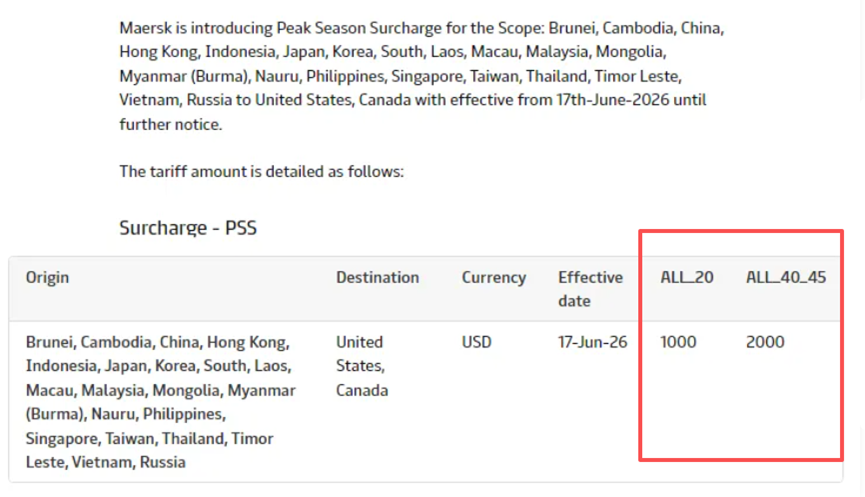
Image source: Maersk
-MSC has raised the Emergency Fuel Surcharge (EFS) for Asia to US and Canada routes starting June 1: $540 for US West 40-foot dry containers, $426 for US East 40-foot dry containers;
-ONE also imposed a peak season surcharge on eastbound trans-Pacific cargo starting June 1, with increases ranging from $450–$2,000/FEU;
-Yang Ming, Wan Hai and others are also simultaneously raising rates by $1,000–$1,500/FEU starting June 1.
The general consensus in the industry is: this wave of high prices will continue for another 1–2 months, basically covering the core window for World Cup stocking.

Image source:THIRTEEN
Yiwu is Busy, Sellers are Calculating Costs
In this wave, Yiwu remains the most intuitive indicator. As the global hub for small commodities, the export value of Yiwu sports goods and equipment reached about 2.83 billion yuan in Q1 2026 (up about 12% year-on-year), and categories such as footballs, fan uniforms, cheering props, and licensed souvenirs have entered the concentrated shipping stage. For many cross-border sellers relying on the Yiwu supply chain, orders are not the problem; the problem is how to ship the goods, and whether they can afford to ship them.
After the freight rates jumped, the first to be squeezed are product lines with low customer unit price, low gross margin, heavy cargo/large items that originally relied on "small profits and quick turnover".Once the first leg price rises, part of the price advantage is instantly eaten away—either raise prices (sacrificing conversion rate), swallow reduced profits, or cut advertising and promotion budgets (sacrificing traffic). Every path requires careful calculation.
Another easily overlooked but more troublesome risk lies in customs clearance. Recently, US CBP customs risk control has tightened, with increased intensity of 5H inspection (Entry Processing Hold). If there are problems with declaration information, documents, or compliance, cargo detention, delays, and port stays will directly translate into capital occupation and default risk—and during periods of high freight rates, any delay in any link costs much more than usual.
Container skipping is also becoming frequent. When slots are tight, shipping companies prioritize contract customers, and the probability of spot market containers being postponed rises significantly, which is especially unfriendly for platform sellers with clear listing deadlines.
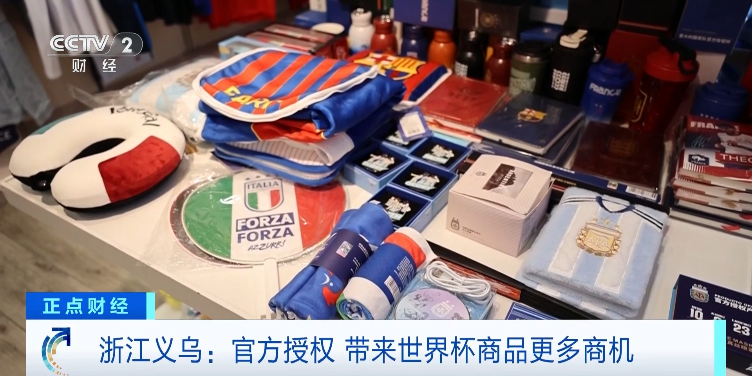
Image source: Xinhua Net
But there are ways to cope. Based on current industry feedback, there are three directions sellers should plan ahead for:
First, lock in slots early and confirm peak season slot resources with freight forwarders as soon as possible to avoid the risk of last-minute container skipping; second, recalculate costs and pricing. With freight rates up more than 60% in a month, if you stick to previous pricing strategies, you may see order volume rise but profits shrink; third, ensure compliance review of customs clearance documents. Especially with tighter 5H inspections, authenticity of documents and clear declarations are particularly important.
This is cross-border e-commerce: every seemingly distant event eventually turns into real orders and bills on the desks of cross-border sellers through shipping routes and containers. This time, the World Cup hasn't officially started yet, but on the shipping track, the real competition has already begun.
What this signal means for growth teams
This market signal should be treated as an operating prompt, not a standalone trend. The brand question is whether the team can connect TikTok content, creators, paid media, commerce readiness, and reporting into one measurable growth cycle.
Commercial read
- Market signal: TikTok Marketing Information and Solutions
- Published: June 4, 2026
- Commercial lens: TikTok Ads, creators, TikTok Shop, live commerce, and reporting.
- Source transparency: the original source linked in this article
What brands should do next
- Identify the market, audience, product group, and KPI this signal could affect.
- Turn the insight into a small TikTok creative, creator, Shop, or paid media test before scaling spend.
- Add FAQ, offer clarity, product proof, and contact paths so traffic can convert instead of only reading.
- Review weekly performance across reach, click quality, Shop actions, creator output, and revenue impact.
Tuke Marketing helps brands connect TikTok Ads, creator partnerships, TikTok Shop operations, live commerce, and reporting into one accountable operating system.
What should brands do with this TikTok signal?
Brands should translate the signal into a focused operating test across creative, creators, TikTok Shop readiness, paid media, and reporting before increasing budget.
How does Tuke Marketing evaluate this kind of news?
Tuke Marketing reviews platform news through market timing, category demand, creator supply, commerce readiness, and measurable growth actions.
When should a team contact Tuke about this topic?
A team should contact Tuke when it needs to turn a TikTok market signal into a practical launch, creator, advertising, live commerce, or reporting plan.
Source transparency: Tuke cites the original source linked in this article and adds its own operating analysis for brands evaluating TikTok growth decisions.