
For friends doing Tuke e-commerce, do you have this feeling: the biggest fear every day is not having few orders, but buyers suddenly sending a message“I want to return this”? The profit from selling a single item is not much, but once there is a return, shipping fees, storage fees, secondary processing fees... all these costs stack up, and if you’re not careful, you lose all the profit from that order. What’s even more headache-inducing is that the returned goods, after a long international logistics journey back to China, have already missed the best sales period.
But have you ever thought,actually those troublesome returns are not a hassle, but a hidden“gold mine”? The key is whether you know how to use overseas warehouses to master reverse logistics.
Image source: Internet
I. Why must you pay attention to reverse logistics?
Let’s look at some data to understand. Data shows thatthe global reverse logistics market size in 2025 is $839.88 billion, expected to grow from $880.61 billion in 2026 to $1,260.8 billion in 2034, with a compound annual growth rate of 4.6%.Meanwhile, the return rate for Tuke e-commerce is as high as20% to 30%, much higher than the 8% to 10% of physical retail. In other words, for every 10 products sold, an average of 2 to 3 will be returned.
The traditional approach is to ship the returned goods back to China, with logistics costs alone being frighteningly high, not to mention the cumbersome processes of customs clearance, inspection, and re-listing. Many sellers simply choose“direct refund, keep the goods”, which seems to save shipping costs, but actually loses the value of the goods.
Therefore, learning to use overseas warehouses for reverse logistics is essentially learning to turn“return costs” into “secondary sales revenue”. Next, I’ll break down the specific tactics in three steps.
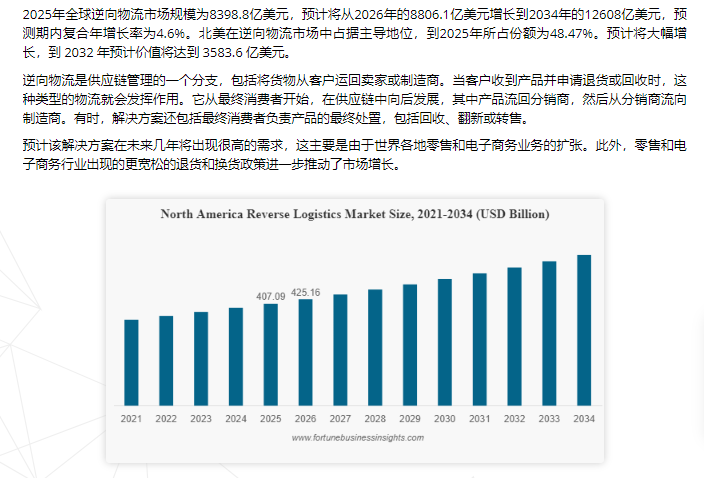
Image source:fortune business insights
Step 1: Use overseas warehouses to build a return“receiving station”
The first step in reverse logistics is to give returned goods a“landing point”. In the past, many sellers could only send returns back to domestic warehouses, with cycles as long as 30 to 45 days. Now, overseas warehouses are your “return outposts” in overseas markets.
Starting April 1, 2026, the General Administration of Customs has promoted the cross-customs return model for Tuke e-commerce retail export goods nationwide. Simply put, previously your goods had to return from the same place they were exported, making the logistics path long and expensive. Now, you can flexibly choose any customs port nationwide to handle returns, greatly reducing return costs.
For example, fast fashion giantSHEIN launched a reverse logistics service covering 4,000 outlets in Brazil, allowing consumers to drop off returned goods at nearby cafes, beauty salons, and other partner locations, completing the return by scanning a code. Compared to home pickup, this service saves 20% in costs.
For you, you don’t necessarily need to set up4,000 outlets, but the idea can be borrowed: cooperate with overseas warehouses in advance, establish return receiving hubs locally, so returned goods have a clear destination, rather than “returns with nowhere to go”.

Image source: Internet
Step 2: Upgrade overseas warehouses to“refurbishment workshops”
After returned goods enter the overseas warehouse, the next operations are the core value of reverse logistics—inspection, sorting, refurbishment, and resale.
Many sellers process returns slowly because the warehouse doesn’t know how to judge the goods after receiving them. Can this product still be sold? Does it need repair? If the packaging is damaged, can it be relisted? These judgments rely entirely on manual labor, which is inefficient and prone to errors.
The ideal approach is to establish a standardized quality inspection process within the overseas warehouse. When goods arrive, their condition is graded immediately: those in perfect condition are directly listed for sale, those with minor flaws go to the refurbishment area for relabeling and repackaging, and severely damaged items are scrapped or dismantled for recycling.
Anker Innovations (Anker) has launched a 30-day worry-free local return policy in multiple countries overseas, allowing consumers to apply with one click via the app and send goods to partner outlets. More importantly, Anker has built a global after-sales digital system that can track the entire process from receiving returns to inspection, repair, and resale. This system makes returns no longer a “black box”, but visible operational data.
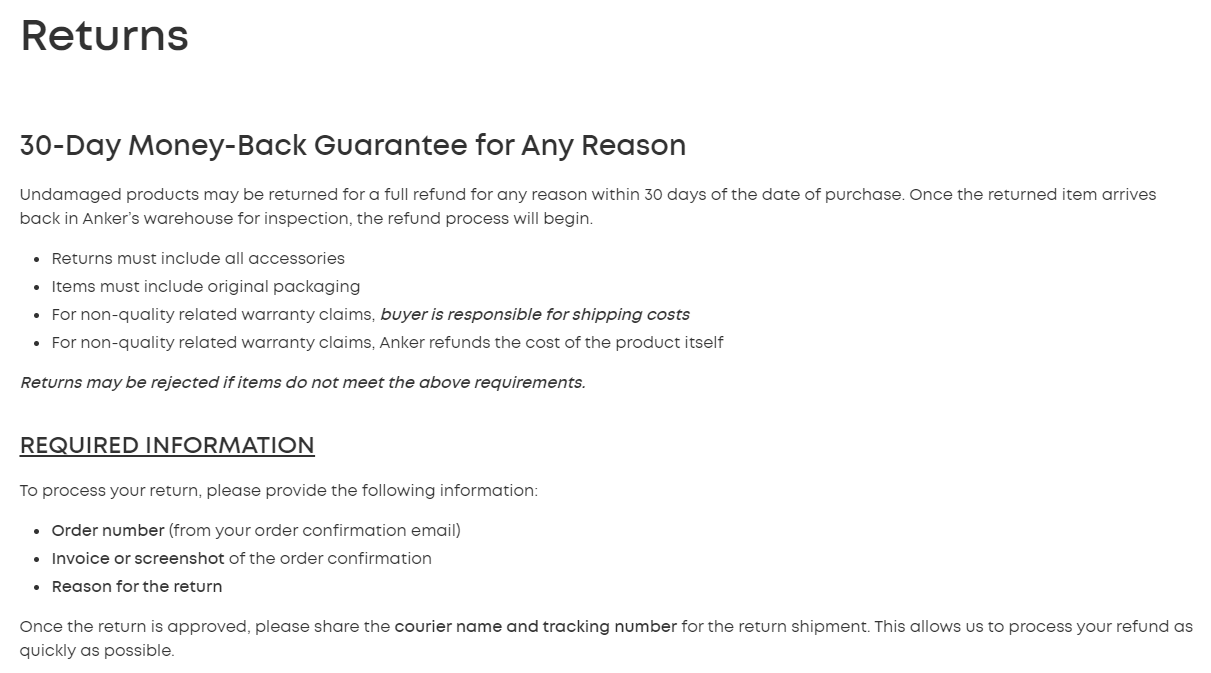
Image source:Anker
Step 3: UseTikTok to connect the “last mile” of the return experience
After talking about the“back-end” operations, let’s discuss the “front-end”. Reverse logistics is not just about the warehouse, it also affects consumers’ impression of your brand. And TikTok is precisely the best platform to connect you with consumers and ease return anxiety.
TikTok Shop has recently launched several new return management features, including automatic approval of after-sales requests, covering returns, refunds, exchanges, and more. Sellers can also set their own return periods (ranging from 14 to 90 days). These features greatly reduce the time sellers spend manually handling after-sales requests and lower errors caused by human negligence.
But a smarter approach is not to passively handle returns, but to proactively useTikTok’s content ecosystem to reduce return rates. For example, you can use short videos to show the real size of products, usage methods, and even shoot a “unboxing + return process demonstration” video to tell buyers “if it doesn’t fit, here’s how we handle it”. This transparency will make consumers more confident in placing orders.
Image source: Internet
Reverse logistics is not a cost, but an asset
From passively dealing with returns to actively managing reverse logistics, the key transformation lies in how you view returns.
In the past, Tuke e-commerce sellers’ attitude towards returns was often“avoid if possible, exempt if possible”. But today, with the full implementation of cross-customs return policies and the widespread adoption of digital tools, we now have the tools and conditions to turn “returns” from a burden into an asset.
The good news is, fromJanuary 1, 2026 to December 31, 2027, Tuke e-commerce export goods returned in their original condition within 6 months due to unsold or returned reasons can be exempted from import duties and import VAT and consumption tax. This tax incentive, combined with the cross-customs return policy, is the best window for sellers to optimize reverse logistics.
So, don’t let returns eat up your profits anymore. Build your overseas warehouse return network, optimize your quality inspection and refurbishment process, and useTikTok to tell your after-sales story. Once you master reverse logistics, you’ll have a competitive advantage that others can’t see.
What this signal means for growth teams
This market signal should be treated as an operating prompt, not a standalone trend. The brand question is whether the team can connect TikTok content, creators, paid media, commerce readiness, and reporting into one measurable growth cycle.
Commercial read
- Market signal: TikTok marketing tips - short video marketing methods
- Published: May 6, 2026
- Commercial lens: TikTok Ads, creators, TikTok Shop, live commerce, and reporting.
- Source transparency: the original source linked in this article
What brands should do next
- Identify the market, audience, product group, and KPI this signal could affect.
- Turn the insight into a small TikTok creative, creator, Shop, or paid media test before scaling spend.
- Add FAQ, offer clarity, product proof, and contact paths so traffic can convert instead of only reading.
- Review weekly performance across reach, click quality, Shop actions, creator output, and revenue impact.
Tuke Marketing helps brands connect TikTok Ads, creator partnerships, TikTok Shop operations, live commerce, and reporting into one accountable operating system.
What should brands do with this TikTok signal?
Brands should translate the signal into a focused operating test across creative, creators, TikTok Shop readiness, paid media, and reporting before increasing budget.
How does Tuke Marketing evaluate this kind of news?
Tuke Marketing reviews platform news through market timing, category demand, creator supply, commerce readiness, and measurable growth actions.
When should a team contact Tuke about this topic?
A team should contact Tuke when it needs to turn a TikTok market signal into a practical launch, creator, advertising, live commerce, or reporting plan.
Source transparency: Tuke cites the original source linked in this article and adds its own operating analysis for brands evaluating TikTok growth decisions.