
On January 23, 2026, TikTok officially released an announcement, declaring the establishment of TikTok USDS Joint Venture LLC (TikTok U.S. Data Security Joint Venture).
Thus, after years of negotiations, the separation of TikTok's U.S. business and data security talks have finally reached a conclusion.
This means that over 200 million U.S. users can continue using TikTok, and about 7.5 million American businesses can maintain their global operations.
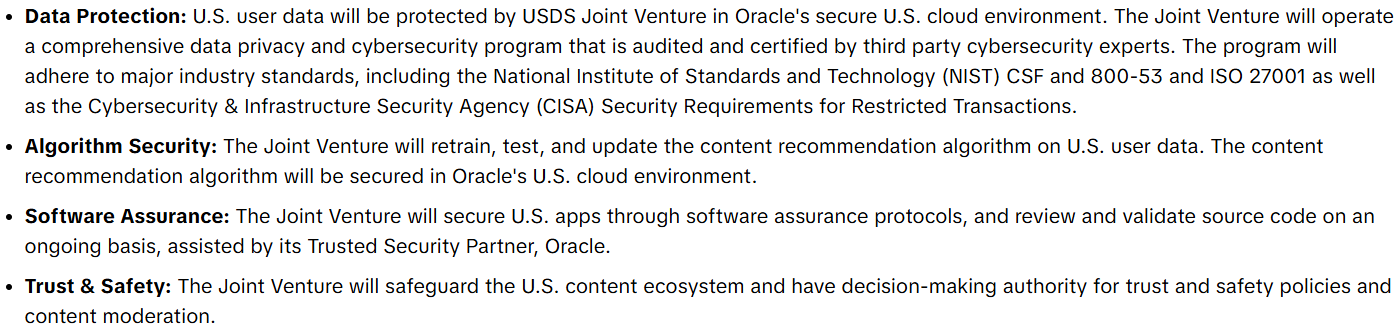
Image source:TikTok official website
U.S.TikTok's New Structure Unveiled
This restructuring plan clarifies the new operational landscape for TikTok in the U.S. According to official documents, the new TikTok USDS company will mainly be responsible for:
-U.S. user data management, security review, and algorithm compliance;
-Operated by an independent management team, not subject to direct control by ByteDance.
The company's CEO is Adam Presser, and the Chief Security Officer is Will Farrell. The board consists of seven members, most of whom are U.S. nationals, with TikTok CEO Shou Zi Chew also on the board.
TikTok emphasizes that the intellectual property rights of the algorithm remain with ByteDance. The joint venture only receives usage authorization, and algorithm reviews must be conducted within ByteDance's transparency center, with the entire process monitored, but any copying, downloading, or photographing is strictly prohibited.
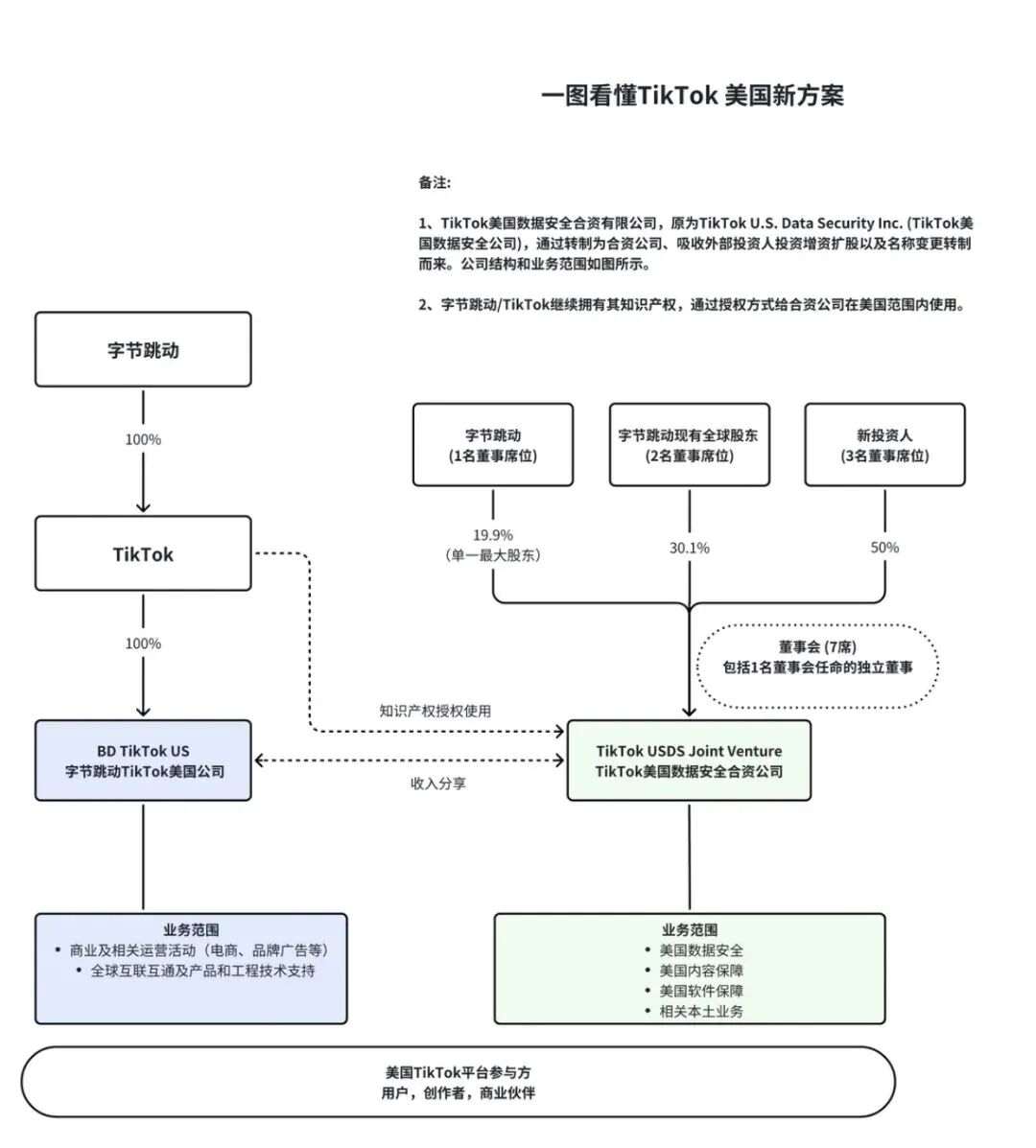
Image source: Internet
Equity Structure Revealed: ByteDance Remains Largest Single Shareholder
The joint venture's equity allocation has also been officially disclosed:
· Oracle:15% stake
· Silver Lake:15% stake
· Abu Dhabi MGX Fund:15% stake
· ByteDance's partial investors and affiliates:30.1% combined
· ByteDance:Directly holds 19.9%
In this way, ByteDance-related parties hold about 50% in total, remaining the largest single shareholder. According to U.S. media reports, this deal values TikTok's U.S. business at about $14 billion, but ByteDance's actual earnings have not been disclosed.
Image source: Internet
"Dual Entity" Operational Model Established
According to the plan, TikTok will adopt a "dual entity" operational model in the U.S. in the future:
· TikTok USDS joint venture is responsible for user data and algorithm security;
· TikTok U.S. company (wholly owned by ByteDance) is responsible for e-commerce, advertising, and market promotion functions.
This structure meets U.S. security regulatory requirements while ensuring TikTok's coherent operation within its global product system, providing a practical path for Sino-U.S. business cooperation.
Multi-perspective: Balance in Compromise
Fudan University international affairs expert Shen Dingli believes that this plan achieves a balance between data security and commercial autonomy through a clever separation of equity and responsibilities, addressing the core concerns of U.S. regulators while safeguarding key Chinese interests.
Chinese Ministry of Commerce spokesperson He Yungqian previously responded that China and the U.S. have reached a basic consensus on TikTok and other issues based on mutual respect and equal consultation. He hopes the U.S. will provide a fair, transparent, and non-discriminatory business environment for Chinese companies to operate long-term in the U.S.
Industry Impact: A New Compliance Example
The TikTok U.S. plan is seen as an innovative example for multinational tech companies to address conflicts between data sovereignty and regulation.
This move not only resolves political and security risks in the process of business globalization, but also explores a balanced path in terms of technology, capital, and governance.
For the e-commerce industry, TikTok Shop will continue to expand in the U.S. market, maintaining its core advantage in social content and commercial conversion. In the future, its model may become a reference sample for other large internet companies to operate in compliance in international markets.
TukeObservation:
TikTok's rebirth in the U.S. not only wins a "lifeline," but also finds a survival balance in the game of compliance and sovereignty. For cross-border sellers, this means TikTok Shop's e-commerce ecosystem will continue to expand in the U.S. market, and the integration of social and commerce will remain one of the global growth engines in 2026.
Short answer for decision makers
This TikTok business signal should be used as a planning prompt, not a standalone trend. The practical question is whether your brand has the market readiness, creator supply, Shop conversion path, paid-media structure, and reporting cadence to act on it now.
Key facts
- Market signal: TikTok Marketing Information and Solutions
- Published: January 26, 2026
- Source transparency: the original source linked in this article
Tuke recommendation
Choose one market, one product group, one creator cohort, and one KPI for the next operating cycle. Then align creative testing, TikTok Shop optimization, live commerce readiness, and weekly reporting around that single decision.
What should brands do with this TikTok signal?
Brands should translate the signal into a focused operating test across creative, creators, TikTok Shop readiness, paid media, and reporting before increasing budget.
How does Tuke Marketing evaluate this kind of news?
Tuke Marketing reviews platform news through market timing, category demand, creator supply, commerce readiness, and measurable growth actions.
When should a team contact Tuke about this topic?
A team should contact Tuke when it needs to turn a TikTok market signal into a practical launch, creator, advertising, live commerce, or reporting plan.
Source transparency: Tuke cites the original source linked in this article and adds its own operating analysis for brands evaluating TikTok growth decisions.