
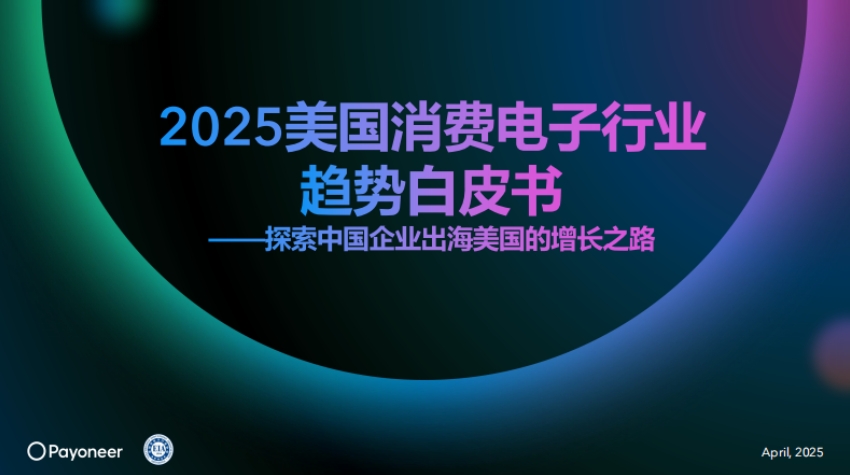
This document is Payoneer's "2025 U.S. Consumer Electronics Industry Trends White Paper," which mainly explores the growth path of Chinese enterprises expanding into the U.S. market, covering market environment, opportunities, challenges, and response strategies, as detailed below:
- U.S. Market Environment: The U.S. is the world's largest consumer market. In 2024, 26% of its electrical/electronic equipment imports relied on the Chinese supply chain. However, policies such as increased tariffs have put short-term pressure on Chinese exports, while in the long term, they also drive enterprise transformation and upgrading. China is the second largest source of U.S. imports; in 2024, the proportion of U.S. imports of electrical/electronic equipment from China was 26%, though the import growth rate has fluctuated.
- Emerging Development Opportunities:
- Consumer Group Transformation: Generation Z and the silver-haired population have become new consumer forces. Gen Z pursues personalization and a sense of technology, while the elderly focus on age-friendly and health products. Their consumption needs drive market diversification.
- Changes in Consumption Trends: Under inflation, consumers pursue higher cost performance and pay attention to sustainability, health, and convenience. For example, 34% of consumers believe environmental issues affect health, and Gen Z pays more attention to sustainable products.
- Product Innovation Directions: AI technology is driving consumer electronics towards "intelligent connectivity of everything," such as Huawei's smart screen interconnecting with smart home devices; products like projectors and drones are innovating in niche scenarios to meet diverse consumer needs; product design integrates aesthetics and technology, such as mural TVs and art speakers.
- Channel Integration and Reconstruction: Online penetration of U.S. consumer electronics is high, while offline channels are reviving through upgraded experiences. Social media influences consumption decisions, such as rapid growth in TikTok Shop transactions, and small and medium-sized businesses are breaking through via social e-commerce.
- Challenges of Overseas Expansion: Chinese enterprises face challenges such as volatile tariff policies, cultural differences, exchange rate fluctuations, fierce market competition, and stringent technical standards. For example, tariffs on some goods are as high as 145%, and local and international brands have established barriers.
- Response Strategies and Cases:
- Product and Brand: Accurately identify local needs, focus on innovation in key areas such as intelligence and environmental protection, and promote brand localization upgrades, such as a technology company focusing on boutique branding.
- Channels and Marketing: Deploy omni-channel strategies, leverage e-commerce platforms and social media, such as Payoneer's "Olive Branch Program" to help companies enter mainstream platforms.
- Supply Chain and Capital: Build a "China+N" supply chain network, use technology tools to optimize capital management, such as Payoneer providing solutions for cross-border capital flows and exchange rate hedging.
- Case Reference: Taking Payoneer's support for a smart wearable device company as an example, it demonstrates solutions in cross-border e-commerce onboarding, exchange rate management, and payment settlement.
- The transformation of the U.S. market brings both opportunities and challenges. Chinese enterprises need to reshape supply chain resilience, shift from "cost competition" to "value co-creation," and achieve global development through precise insights, innovation, and ecosystem collaboration.


What this signal means for growth teams
This market signal should be treated as an operating prompt, not a standalone trend. The brand question is whether the team can connect TikTok content, creators, paid media, commerce readiness, and reporting into one measurable growth cycle.
Commercial read
- Market signal: TikTok Industry Research and Analysis Report
- Published: May 27, 2025
- Commercial lens: TikTok Ads, creators, TikTok Shop, live commerce, and reporting.
- Source transparency: the original source linked in this article
What brands should do next
- Identify the market, audience, product group, and KPI this signal could affect.
- Turn the insight into a small TikTok creative, creator, Shop, or paid media test before scaling spend.
- Add FAQ, offer clarity, product proof, and contact paths so traffic can convert instead of only reading.
- Review weekly performance across reach, click quality, Shop actions, creator output, and revenue impact.
Tuke Marketing helps brands connect TikTok Ads, creator partnerships, TikTok Shop operations, live commerce, and reporting into one accountable operating system.
What should brands do with this TikTok signal?
Brands should translate the signal into a focused operating test across creative, creators, TikTok Shop readiness, paid media, and reporting before increasing budget.
How does Tuke Marketing evaluate this kind of news?
Tuke Marketing reviews platform news through market timing, category demand, creator supply, commerce readiness, and measurable growth actions.
When should a team contact Tuke about this topic?
A team should contact Tuke when it needs to turn a TikTok market signal into a practical launch, creator, advertising, live commerce, or reporting plan.
Source transparency: Tuke cites the original source linked in this article and adds its own operating analysis for brands evaluating TikTok growth decisions.