
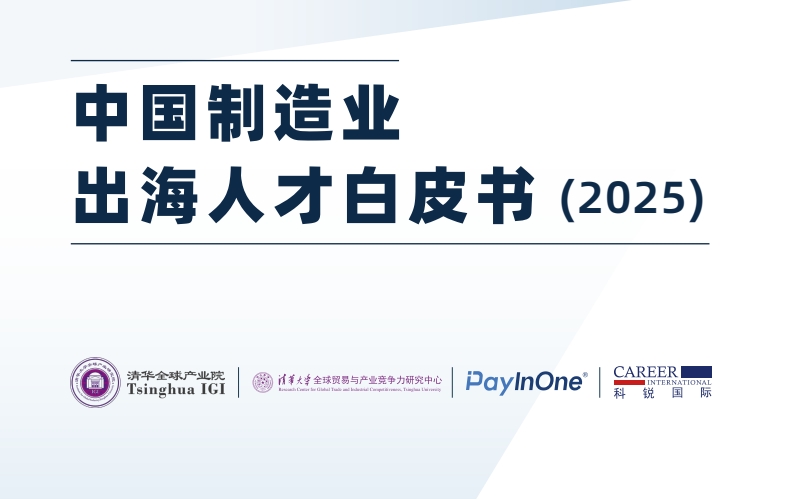
This "White Paper on Overseas Talent in China's Manufacturing Industry (2025)" mainly explores talent-related issues in the process of Chinese manufacturing going global, including the current situation, demand, challenges, and response strategies.
1. Current Situation and Trends of Going Global: China's manufacturing outbound investment continues to grow, with a compound annual growth rate of 7.8% in outbound direct investment flows from 2019 to 2023, reaching USD 27.34 billion in 2023. At the same time, the manufacturing industry is upgrading from labor-intensive products to high-end, high value-added products, such as an increased proportion of electromechanical product exports and a decreased proportion of labor-intensive product exports. In addition, enterprises are actively deploying in emerging markets and optimizing industrial chain configurations. Industries such as machinery and equipment, electronics and electrical appliances, new energy, and automobiles are achieving localized production by establishing R&D, production, and sales bases overseas.
2. Talent Demand Characteristics: The demand for overseas talent is increasing. From 2021 to 2023, the number of overseas talents in China's manufacturing industry has continued to rise, and talent mobility shows a multi-directional development trend of "going out" and "bringing in". Overseas enterprises are mainly expanding into emerging markets such as Southeast Asia, Europe, and Latin America, where talent concentration is high. Overseas employment models are diversified, with an increasing proportion of flexible employment, and Southeast Asia has the highest proportion of flexible employment. Job demand is expanding from sales and functional roles to production operations and technical R&D, and talent requirements have shifted from focusing on 0-1 experience to emphasizing localized operations.
3. Talent Management Challenges: China's manufacturing industry faces multiple challenges in going global. The cost of going global is high, including the capital and time costs of setting up overseas companies, relocation costs, and the costs of full-time and flexible employment; cultural and compliance issues are prominent, with cultural differences affecting business operations and strict compliance requirements in recruitment, compensation, etc.; talent attraction and acquisition are difficult due to weak corporate brand image and inefficient talent selection; there are problems in talent training and development, such as high training costs and insufficient professional training opportunities, large differences in compensation and incentive methods, lack of career development path design, and difficulties in implementing digital talent management.
4. Winning Strategies for Talent Management: Enterprises should clarify their globalization positioning, formulate strategies based on their own situation and target market characteristics, pay attention to financial planning, avoid excessive concentration of risks, and develop talent management strategies according to development stages. Adhere to the "people-oriented" concept, respect employee differences, build an inclusive corporate culture, implement a "one country, one policy" approach, and solve the problem of differentiated management between local and domestic employees. Choose suitable partners and evaluate their professional background and service capabilities. Enhance the employer brand image overseas, promote corporate culture, and provide a good work experience and development support. Empower talent going global with artificial intelligence technology and build a digital human resources management system. Systematically optimize talent recruitment and management mechanisms, including understanding the labor situation in target countries, cultivating talent skills, compliant employment management, building local decision-making teams, and opening up career development paths.
5. Future Outlook: In the future, it will become more difficult for China's manufacturing industry to attract and acquire overseas talent, especially in popular regions such as Southeast Asia and Europe and the United States. ESG compliance requirements will change talent recruitment and management strategies, and enterprises need to focus on candidates' sustainable development concepts and increase ESG training for employees. Digital technology will provide innovative solutions for talent recruitment and development, reducing costs and improving efficiency. The global flow of talent is accelerating, and enterprises need to build a global talent pool. The rise of flexible employment and remote work will prompt enterprises to pay more attention to employees' personalized needs and development.


What this signal means for growth teams
This market signal should be treated as an operating prompt, not a standalone trend. The brand question is whether the team can connect TikTok content, creators, paid media, commerce readiness, and reporting into one measurable growth cycle.
Commercial read
- Market signal: TikTok Industry Research and Analysis Report
- Published: March 17, 2025
- Commercial lens: TikTok Ads, creators, TikTok Shop, live commerce, and reporting.
- Source transparency: the original source linked in this article
What brands should do next
- Identify the market, audience, product group, and KPI this signal could affect.
- Turn the insight into a small TikTok creative, creator, Shop, or paid media test before scaling spend.
- Add FAQ, offer clarity, product proof, and contact paths so traffic can convert instead of only reading.
- Review weekly performance across reach, click quality, Shop actions, creator output, and revenue impact.
Tuke Marketing helps brands connect TikTok Ads, creator partnerships, TikTok Shop operations, live commerce, and reporting into one accountable operating system.
What should brands do with this TikTok signal?
Brands should translate the signal into a focused operating test across creative, creators, TikTok Shop readiness, paid media, and reporting before increasing budget.
How does Tuke Marketing evaluate this kind of news?
Tuke Marketing reviews platform news through market timing, category demand, creator supply, commerce readiness, and measurable growth actions.
When should a team contact Tuke about this topic?
A team should contact Tuke when it needs to turn a TikTok market signal into a practical launch, creator, advertising, live commerce, or reporting plan.
Source transparency: Tuke cites the original source linked in this article and adds its own operating analysis for brands evaluating TikTok growth decisions.