
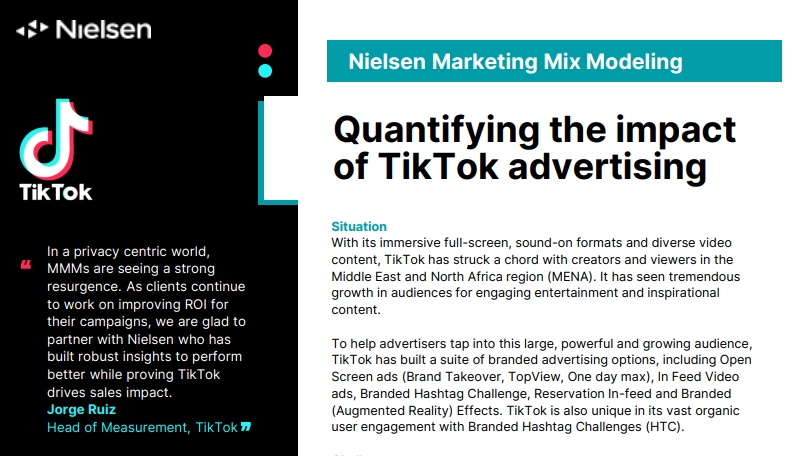
Nielsen TikTok Marketing Mix Modeling (MMM) study, aimed at quantifying the impact of TikTok advertising on FMCG brands in the Middle East and North Africa (MENA) region, with the main content as follows:
1. Research Background
- Development of TikTok in the MENA region: TikTok is loved by creators and audiences for its immersive full-screen, sound-on format and diverse video content, and has a large audience. It offers a variety of brand advertising options, such as TopView ads, in-feed video ads, branded hashtag challenges, etc.
- Research Purpose: Many marketers rely on third-party measurement providers to assess advertising impact. Due to the diversity and high traffic of TikTok ad products, robust methods and best practices are needed to quantify its business value. Therefore, TikTok commissioned Nielsen to conduct a marketing mix modeling study on 16 brands in Saudi Arabia, UAE, and Egypt (covering three categories: food & beverage, health & personal care, and home care).
2. Research Results
- TikTok advertising has a significant impact on sales
- Overall ROAS: TikTok's total return on ad spend (ROAS) in the MEA region is $1.83. The ROAS of paid ads is 3.5 times the average of other Nielsen-measured media, 56% higher than other digital media (excluding TikTok), and higher than all other media.
- ROAS by category: In the food & beverage category, the ROAS of TikTok paid ads is higher than all other media. The health & personal care and home care categories also achieved higher ROAS, and all categories exceeded the FMCG industry benchmark.
- Multiple ad formats and long-term campaigns can improve ROAS
- Multiple ad formats: Running multiple ad formats simultaneously in TikTok ad campaigns can improve ROAS. Compared to brands focusing on only one format, brands implementing multiple formats can increase ROAS by 10%, and by 31% in the UAE. Among different categories, the improvement in ROAS from multiple formats versus single format is more significant in food & beverage and health & personal care categories.
- Long-term campaigns: Running in-feed ads on TikTok for more than 20 weeks can increase ROAS by 16% compared to brands running ads for less than 20 weeks.
3. MMM Measurement Best Practices: In marketing mix modeling, TikTok should be modeled as an independent entity and should not be bundled with other digital or social strategies. TikTok can provide data extraction by ad product to facilitate measurement of its effectiveness and efficiency.


What this signal means for growth teams
This market signal should be treated as an operating prompt, not a standalone trend. The brand question is whether the team can connect TikTok content, creators, paid media, commerce readiness, and reporting into one measurable growth cycle.
Commercial read
- Market signal: TikTok Industry Research and Analysis Report
- Published: September 30, 2024
- Commercial lens: TikTok Ads, creators, TikTok Shop, live commerce, and reporting.
- Source transparency: the original source linked in this article
What brands should do next
- Identify the market, audience, product group, and KPI this signal could affect.
- Turn the insight into a small TikTok creative, creator, Shop, or paid media test before scaling spend.
- Add FAQ, offer clarity, product proof, and contact paths so traffic can convert instead of only reading.
- Review weekly performance across reach, click quality, Shop actions, creator output, and revenue impact.
Tuke Marketing helps brands connect TikTok Ads, creator partnerships, TikTok Shop operations, live commerce, and reporting into one accountable operating system.
What should brands do with this TikTok signal?
Brands should translate the signal into a focused operating test across creative, creators, TikTok Shop readiness, paid media, and reporting before increasing budget.
How does Tuke Marketing evaluate this kind of news?
Tuke Marketing reviews platform news through market timing, category demand, creator supply, commerce readiness, and measurable growth actions.
When should a team contact Tuke about this topic?
A team should contact Tuke when it needs to turn a TikTok market signal into a practical launch, creator, advertising, live commerce, or reporting plan.
Source transparency: Tuke cites the original source linked in this article and adds its own operating analysis for brands evaluating TikTok growth decisions.